Timetable:
“Local” CDT will be our time in all discussions. Travel on Friday or early Saturday morning depending on location. Operations will commence at 0730 on Saturday morning August 20th, 2005. Operations will continue until 1830 Saturday when the tertiary focus will become primary. In other words, Rovers would like to attempt contacts with WØPHD, KØAWU, VE4MA, NTØV and other distant stations from 1830 to 2000 on Saturday night. Cell phone liaison is simplest. Sisseton may be able to assist with liaison. By 2000 on Saturday, operations will end in order to dine and get a good night of sleep. Sunday, August 21st, 2005 will have operations begin at 0700. Continue operations through the day till 1600. Operations beyond 1600 will depend on conditions and will of the participants.
Liaison:
Regional Liaison will be primarily cell phones. The region now has very good cell phone coverage. For liaison with KØAWU/WØPHD, 2m SSB is required—use 144.260. NØUK, W9FZ, and WA2VOI are taking 2m SSB gear sufficient to work Warren, MN. Local site chatter and rover-pack barking will be on 2m FM—146.46 suggested. For Lonsdale to work AWU/PHD, they’ll need 2m SSB or a relay via Sisseton (the latter would be easiest). WØGHZ will have 2m SSB at Lonsdale.
Lodging:
Sisseton—NØKP has secured rooms at the Super 8 Motel in Sisseton. Late additions to this group will have to arrange additional rooms.
Rover A+B—W9FZ has arranged for 5 rooms at Smart Choice Inn in Redwood Falls, MN (507-637-3456). Late arrival Sat night is fine and breakfast rolls available Sun morn at 6am.
Lonsdale—Lodging not really required, as operators will return home in the evening.
Food:
Sisseton—Breakfast is available at the motel and at one restaurant. Dinners are available at two restaurants but they close at 9pm. Individuals will supply their own lunches and snacks at the site.
Rover A+B—Breakfast will be secured enroute on Saturday and in Redwood Falls on Sunday. Individuals will supply their own snacks and bevs enroute both days. A lunch break of about 30 minutes is likely during the mid-day.
Lonsdale—Each is on your own.
Operation
Strategy:
Here are the real details on how we intend to do business. From previous experience, we feel that orderly operations will lead to faster QSO times and less fiddle-factor. On to the details:
Locations:
Sisseton: Saturday morning, Sisseton operators will gather at the motel and proceed to breakfast and then the operating site. Sisseton will operate on 10368.100 MHz. They will periodically check frequency versus a standard and bring QSO’s back to frequency. When being contacted by the rovers, Sisseton operators will expect to be worked in the same order. The Rover will control the QSO and be the calling station. If one-minute sequences are required, Sisseton will transmit on EVEN minutes. Long Distance QSO’s with other regional players can occur anytime during the day depending on coordination. Most serious effort will be given during the 1830 to 2000 window on Saturday night.
Sunday will be much like Saturday but begin at 0700. Rovers will generally revisit most of the same spots from the previous day. Additional long distance QSO’s will likely occur between 0700 and 0800 Sunday depending on coordination. Later attempts are also possible, again, depending on coordination.
Lonsdale: Whenever ready on Saturday, Lonsdale should cell phone Rovers indicating they are ready. At the next stop, Rovers will begin attempts with Lonsdale on frequency 10370.500 (146.500ssb on most IF rigs). If one-minute sequences are required with Rovers, Lonsdale will transmit on EVEN minutes. Lonsdale operators should be ready to be contacted in the same order by Rovers. Rovers will control the QSO and be the calling station. When ready, Lonsdale should cell phone Sisseton to indicate their readiness to make contacts. If sequences are required with Sisseton, Lonsdale will transmit on ODD minutes. Lonsdale Church is on Hwy 19 west of I-35. On south side of road at an intersection.
Sunday will be very similar but from a different site such as Vasa or Cannon Falls. Cell phone the Rovers and Sisseton whenever ready. KCØP supplies directions to Vasa: The most direct approach is to take MN 19 east from Cannon Falls past the Vasa church about a mile to Smaland road. The inter-section on MN 19 is marked Goodhue CR 51 to the south and Smaland RD is the gravel to the north. There is also a small power substation at this intersection. Take Smaland RD about 2 miles north to 293 RD and west on 293 RD to the top of the hill. You can see an arc all the way from Madelia 248 deg to Sissiton 292 deg unobstructed. I would estimate the horizon is 3 to 5 miles away. This is an E/W road at 270 deg with beans to the south and we can see over the corn to the north.
Rovers A+B:
Rovers will meet Saturday morning at the Wal-Mart on the south side of Hutchinson before 0730. Talk-in on 146.46. We will proceed to the first operating location promptly in order to begin operations at 0730. The Rover teams will start at either the Wal-Mart or the Airport both on the south side of Hutchison MN (EN24tu). Rovers will call Sisseton on cell phone when ready to start. Rovers will intend to contact the Sisseton operators in the same order and Rovers will control the QSO as the calling station. Rovers will contact Sisseton on 10368.100 MHz. If one-minute sequences are required with either Sisseton or Lonsdale or any other Regional player, Rovers will transmit on ODD minutes. For Lonsdale, once cell phoned that Lonsdale is ready, Rovers will contact Lonsdale operators on 10370.500 MHz (146.500ssb on most IF rigs). Rovers will expect to contact Lonsdale operators in the same order and control the QSO as the calling station.
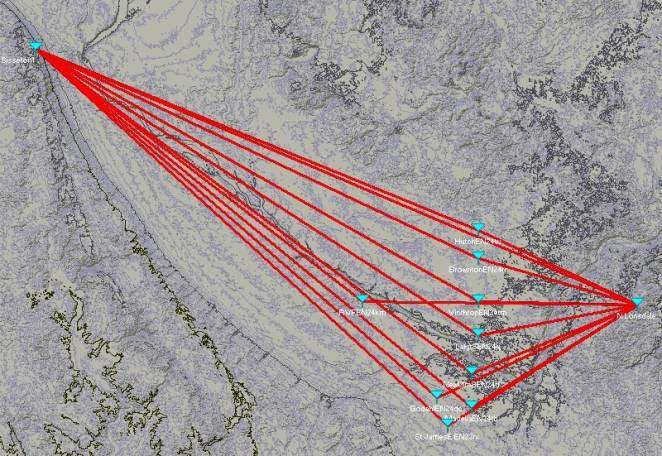
Rovers have a planned route that will be used if conditions allow easy QSOs to Sisseton and Lonsdale. If conditions are poor, the plan is to head west to shorten the distance to Sisseton until signals are strong enough to make QSO’s fast and easy. The planned route starts in Hutchinson and heads south on Hwy 15 till reaching Hwy 60 west beyond Medelia. Travel west on Hwy 60 to St James. Turn north there and travel northward on Hwy 4 to Cosmos. There take Hwy 7 west till reaching Hwy 71. Travel south on Hwy 71 (towards Windom) until time runs out. The goal is to activate 15 locations each day. Anything beyond that is wonderful.
Sunday will be very similar but begin at 0700 and continue till 1600. Generally, the same spots will be revisited. If long-distance QSO’s will be attempted, they will most likely be from the Redwood Falls area and during the period 0700 to 0800.
In order to keep QSO rates higher at Sisseton, Rover A and Rover B will be a few minutes apart in order to use time wisely. The goal is to still provide mutual support to all eight Rovers on finding adequate locations, azimuth, and frequency. That support can still be provided if Rover A is ready to leave as Rover B arrives. Another benefit of separating slightly is easier parking in small locations.
WØPHD + KØAWU: In general, they hope to operate some and have a good time. They will call Sisseton on 2m SSB 144.260 whenever they are ready to try from a location. They intend to try a few locations starting with Warren, MN (EN18oe) but possibly working south or north from there. They hope to work Sisseton, VE4MA, NTØV, and other Canadian stations. In the evening, after 1830 would be the best time to run with the rovers. Rovers should be near Redwood Falls at that point. Also 0700 to 0800 Sunday morning would be a good window. They will most likely move south along Hwy 75 on the Minnesota side. At some point, they may cross to Hwy 81 on the ND side. While they are activating a few locations, they are not trying to be Rovers. Sunday activity is pending.
VE4MA: Will be at home for the Aug weekend. He will be working VE3KRP, VE4TV and VE4CCW multiple times as they move around in Manitoba. Barry will also hook up withVE4KQ, NTØV, WØPHD, KØAWU, and the Sisseton group. Depending on conditions, an attempt with the Rovers near Redwood Falls is possible between 1830 and 2000 on Saturday. Also 0700 to 0800 Sunday morning would be a good window.
VE4KQ: Bruce will be portable at EN09de with 18 and 30-inch dishes and 2w. Bruce will be available by cell phone at 204-771-3607.
KMØT: KMØT
will be north of St Cloud. He’ll have
limited availability and many sites in the area have trees. If he is able to
get on, he will contact Sisseton first.
Depending on what he reports on his site and the conditions, the Rovers
could be alerted to look for Mike on their next stop.
What
if’s:
Equipment Failure: Attempt to fix using group tools and group analysis and expertise. If not successful, consider helping the team by taking on liaison duties, logging assistance, and weather observations. If frustrated, enjoy the beautiful locale with a hike. If disgusted, you’ll probably want to hit the road heading home J .
Bad Weather: Weather may vary from good to downright awful. The plan is to continue operating if there is just drizzle or light rain. Anything worse is not fun and worth waiting out. Communicate “weather hold” status to other groups.
Injury: Team knocks off operation and applies group knowledge and skills to stabilize situation. If Clinic/Hospital is needed, at LEAST one operator will accompany the injured. Remaining operators may then continue operation.
Safety:
RF Safety: We will keep team-members, visitors, and other humans from the area in front of the dishes during transmissions.
Tripping Hazards: Probably the most common safety risk for this trip. Tripod legs, DC power cables, and awning ropes all pose tripping hazards. But also, vehicle tailgates and trunk lids pose threat to injury. The solution will stem from not hurrying and using caution around these threats. Team members will prompt overly energetic teammates to slow down (for safety).
Vehicle Traffic: Rovers are particularly vulnerable.
Lightning: We will go to “weather hold” before lighting becomes likely.
First Aid Kits: Both Sisseton and Rover teams will have First Aid kits. All team members must know where the kit is located.
Clinics/Hospitals: Note signs along the way for Hospitals.
Rules
Reminders:
1. Each operator may operate 24 hours total within the 42-hour contest period 6am local Saturday to Midnight local Sunday. Times off must be clearly indicated in the log. Listening time counts as operating time. Log ON times and log OFF times.
2. A change of location is defined as a move of at least 10 miles (16km). Road miles are OK.
3. Sisseton and Rover intra-team QSO’s must be made over a minimum distance of 1km. It is important to make these contacts to get the benefit of unique callsigns. These may be accomplished anytime during the day but perhaps best in the evening.
4. A legal QSO consists of both operators exchanging callsigns and a unique piece of information and then acknowledging receipt of the information. In this exercise, we will exchange six-digit Grid locators. A “roger”, “R”, or “QSL” constitute acknowledgement. If you have not received the grid square yet, don’t send “R” but rather continue sending calls and grid.
5. Please use standard phonetics and don’t change phonetics in mid-transmission.
6. Please zero beat the Sisseton station, as they will have the most stable frequency. If the QSO is drifting, it is most likely the Rover station drifting.
7. Exchange the information—then do the ragchew comments later in case the path fails.
8. Slow CW is tolerated and encouraged if it means completing a QSO—we are all friends here and there is no CW too slow within our group. Download a decoder sheet at http://w9fz.com/10gsuperior/morsetable.doc. You may want to take the time to build a cheat sheet of all the calls and even your grid “visually”.
9. When conditions are poor, you are encouraged to include both calls and grids at least three times in your transmission. We call this a 3 by 3. WØZQ WØZQ WØZQ de W9FZ W9FZ W9FZ EN24vk EN24vk EN24vk K K K . 4 by 4’s and 5 by 5’s are approved too.
Operating
Tips:
1. Talking too fast is bad. KCØIYT and W9FZ need to particularly take
note J. Slow down and avoid repeats.
2. If conditions are good, annunciate only the required syllables to complete the contact. This will keep rate and efficiency up.
3. Rovers will use an “inch-worm” style with one team moving forward as the second team arrives. The benefit of this is mutual support for safety, azimuth, and frequency. If the lead group gets more than one spot ahead—negative impacts occur. Most notably, loss of mutual support and, more damaging, frequency congestion and Sisseton azimuth spreading.
4. Weaker stations
MUST be certain to peak up stations to the maximum signal strength possible or
risk not being heard or making their QSO’s unnecessarily difficult.
Checklist:
The checklist (Attachment A) is offered as a tool to avoid leaving something important behind. Not every person needs to bring EVERY item, but at least consider whether your team is covered. The final section—Individual 10GHz equipment—might seem overly detailed. I encourage you, once your dish is loaded in your car, to actually use it to look at all of your interconnecting wires etc so that you don’t drive away missing some key piece for YOUR system. If you have a gain horn, bring it along.
After-Action:
Take pictures! Document visually your adventure. Please note 6-digit Maidenhead grid and exact Lat/Lon of operating locations in the following standardized format: DD MM SS.S . These Lat/Lons will help us examine the accomplishments with RadioMobile software. Email postings to the NLRS reflector will carry member’s initial reactions and memories. Logs, weather data, pictures, funny stories and impressions will be shared within the group resulting in a summarizing after-action website report.
Remember FUN!
The details and order described and implied in the preceding pages is not meant to dampen or prevent FUN but rather enhance it! So look around. Be amazed by the rapid and loud signals. Enjoy the camaraderie of your other operators. Have a GREAT time!
Sisseton is on the 6 E Mag Dev line (means subtract from true to get Mag)
Lonsdale is on the 3 E Mag Dev line (means subtract from true to get Mag)
True Bearings suggested by RadioMobile:
Sisseton to Lonsdale 321km 113° Lonsdale to Sisseton 316km 294°
Sisseton to Hutch 235km 112° Lonsdale to Hutch 87km 298°
Sisseton to StJames 274km 133° Lonsdale to StJames 110km 239°
Sisseton to RWF 203km 128° Lonsdale to RWF 133km 272°
Sisseton to Warren 283km 006° Lonsdale to Warren 483km 328°
Sisseton to VE4MA 467km 001° Lonsdale to VE4MA 656km 335°
Sisseton to NT0V 301km 335° Lonsdale to NT0V 579km 314°
Sisseton to VE4KQ 440km 333° Lonsdale to VE4KQ 715km 317°
Warren to VE4KQ 253km 296° RWF to Warren 425km 343°
Warren to NT0V 157km 267° RWF to VE4MA 610km 346°
RWF to NT0V 488km 324°
RWF to VE4KQ 627km 326°